Why Surface Gauss Matters in Industrial Separation
When procurement managers and plant engineers source industrial separation components, the surface magnetic intensity, commonly measured in Gauss, stands as the most critical technical specification. However, a widespread challenge in the B2B sector is the misunderstanding of how these Gauss ratings are measured and how to select the optimal strength for specific production lines. Many factories purchase a standard 12,000 Gauss magnetic bar expecting it to solve all contamination issues, while others utilize incorrect handheld Gauss meter techniques, resulting in falsely low readings and miscalibrated quality control protocols. Understanding the physics behind Rare Earth Magnetic Rods and mastering precise measurement practices is essential to ensuring permanent process security and maximizing your equipment investment.
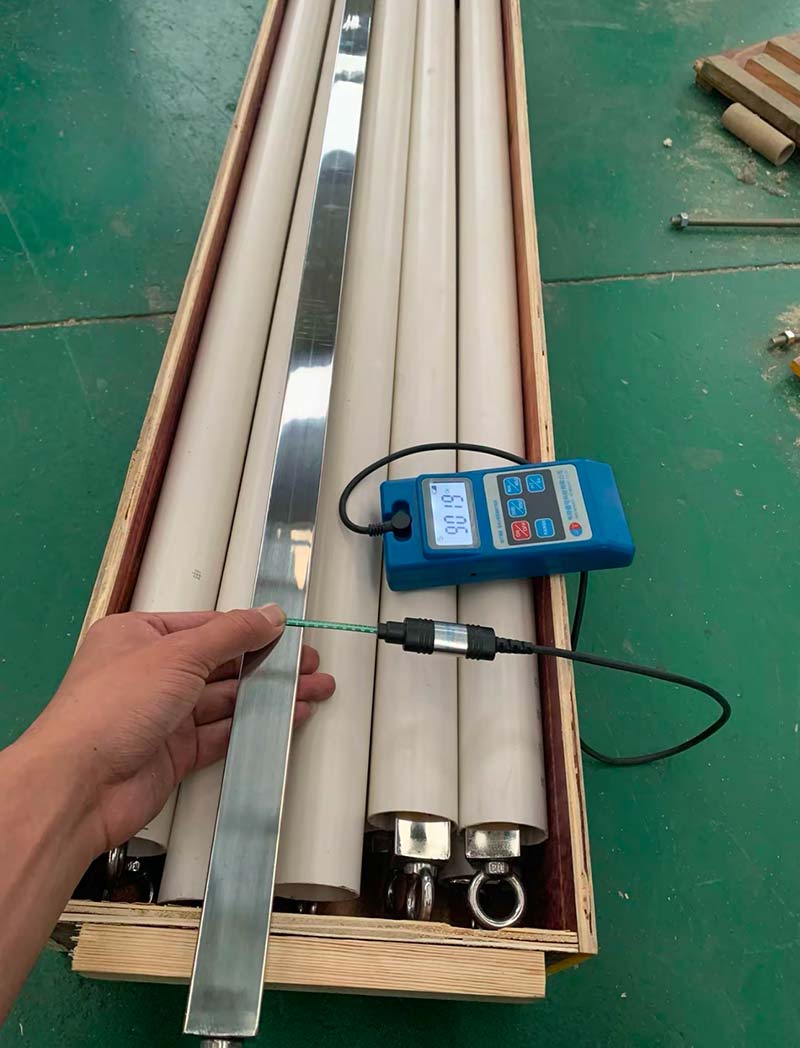
How to Correctly Measure the Surface Gauss of Tube Magnets
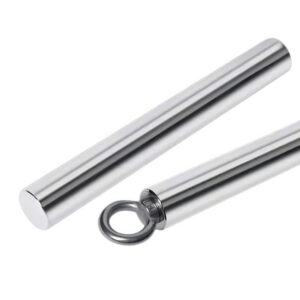
To correctly measure the true peak surface magnetic strength of industrial Tube Magnets, technicians must understand that the highest Gauss levels are not uniformly distributed across the entire stainless steel casing:
- Locate the Axial Poles: The maximum magnetic flux density resides strictly at the axial pole centers, which are the internal boundaries where the alternating permanent magnet disks meet inside the sleeve.
- Proper Probe Placement: When utilizing a digital Gauss meter, the transverse probe must be placed completely flat against the stainless steel surface.
- Smooth Longitudinal Traverse: Slide the probe slowly along the longitudinal axis of the rod. The digital readout will fluctuate significantly as the probe passes over the internal magnetic circuits, and the highest peak value recorded during this smooth traverse represents the actual certified surface Gauss rating.
A Professional Selection Guide Based on Material and Particle Size
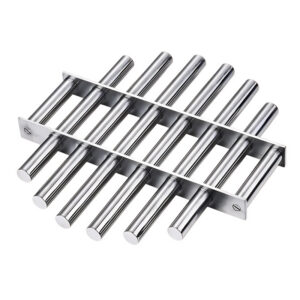
Selecting the ideal Magnetic Filter Bars depends entirely on your material flow dynamics, volumetric bed depth, and the specific particle size of the target metallic contamination:
- 6,000 to 8,000 Gauss: Ideal for standard mechanical tramp iron pieces like dropped assembly screws, loose nuts, and heavy iron wire fragments. This provides more than enough magnetic reach to safeguard downstream crushers.
- 10,000 to 12,000 Gauss: Perfect for fine granular aggregates or agricultural products where moderate flow rates require deeper magnetic penetration to trap iron scales.
- 12,000 to 15,000 Gauss+: Absolutely mandatory when processing fine chemical powders, battery-grade lithium materials, or pharmaceutical ingredients contaminated with sub-millimeter mechanical iron dust and faint rust scales. This extreme force overcomes material friction and securely locks micro-particles in place.
Maintenance and Long-Term Performance Verification
Investing in high-intensity Magnetic Bars requires a proactive maintenance and testing schedule to account for natural thermal and mechanical magnetic decay over years of continuous operation. Industrial guidelines recommend testing all active magnetic bars at least once a year using a calibrated meter, and technical protocols suggest replacing the rods when the recorded peak flux density drops by more than 30% from its original factory specification. At MagnetGlobal, we provide comprehensive technical consulting, custom-calibrated magnet matrices, and professional testing support to guarantee unparalleled separation reliability and world-class industrial performance.