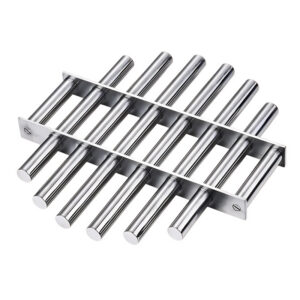
In continuous bulk handling processing lines, standard fixed magnetic grates present a significant operational bottleneck: maintenance downtime. While traditional magnetic grids are highly efficient at intercepting hazardous ferrous particles, operators must manually wipe down every single rod to clear the captured debris. This requires halting the product stream, opening the housing, and scraping away highly abrasive fines—a process that introduces plant downtime and human error.
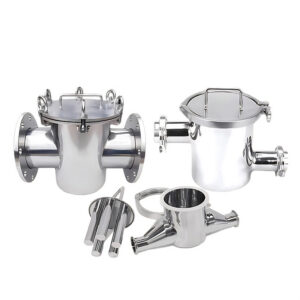
To solve this operational challenge, MagnetGlobal Separation has engineered the Food-Grade Easy-Clean Pull-Out Magnetic Rod Separator (often referred to as drawer-in-housing magnetic filters/grid separators). By decoupling the magnetic core from the protective exterior sleeves, this heavy-duty system allows processing plants to achieve 100% continuous purity control with a maintenance cycle that takes less than 30 seconds, maintaining maximum volumetric flow without compromising on magnetic flux density.
The Mechanics of “Easy-Clean” Slide Technology
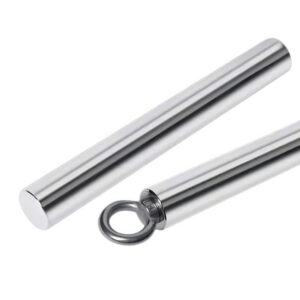
The working principle of a pull-out magnetic drawer is centered around a dual-stage telescopic slide configuration. The assembly consists of two primary sub-components: an outer array of heavy-walled stainless steel tubes (the sanitary sleeves) and an inner array of high-intensity, permanent rare-earth Neodymium (NdFeB) magnetic cores.
During normal operation, the magnetic cores are locked securely inside the sleeves, projecting a powerful, deep-reaching magnetic field across the raw material stream. When the routine maintenance schedule is triggered, the operator simply unclamps the quick-release heavy-duty swing latches and pulls the entire drawer assembly outward along its precision-machined guide rails.

Once the drawer is extended outside the main product chute, the operator pulls the inner magnetic rods out of the protective sleeves. The moment the permanent magnets slide backward, the exterior sleeves lose their magnetic retention field completely. As a result, all trapped tramp iron, micron-sized metal wear, and scale instantly drop off into a collection hopper below via gravity. The entire cleaning process requires zero mechanical tools, zero manual wiping, and zero contact with sharp metal fragments.
Technical Specifications & Selection Matrix
To assist your process engineering team in specifying the correct drawer-in-housing dimensions for your existing vertical chutes, square ducts, or gravity-fed hoppers, the table below outlines our standard dimensional parameters. Every unit is fully customizable via our OEM/ODM support to match specific factory footprints.
Compliance, Sanitary Finishing, and Core Longevity
Because pull-out drawer magnets are widely adopted in food processing, pharmaceutical blending, and fine chemical powder manufacturing, compliance with international sanitary regulations is non-negotiable.
At MagnetGlobal Separation, the exterior housing frame and sleeves are manufactured exclusively from food-grade SUS304 or corrosion-resistant low-carbon SUS316L stainless steel. The tube surfaces undergo automated multi-stage mirror polishing to achieve a surface roughness R_a of less than 0.4um. This guarantees that sticky milk powders, sugar crystals, or chemical compounds cannot bake or accumulate along the tube walls, effectively stopping bacterial reproduction and bio-film formation before it can start.
Furthermore, our internal permanent NdFeB magnet elements are paired with advanced flux-concentrating steel plates to ensure a uniform surface magnetic field that reaches up to 12,000 Gauss. The complete system operates with a passive design, consuming 0 kW of electricity. Protected by air-tight, seamless laser-welded sleeves, the high-coercivity rare-earth core remains fully insulated against moisture, oxidation, and process vibrations, maintaining a magnetic degradation rate of less than 1% over a 10-year service life under standard temperature ranges up to 80 degrees Celsius.
Target B2B Applications
- Food Sector: Processing lines for infant formula, flour milling, cocoa powder, spices, and starch.
- Pharmaceuticals: Inlets for tablet pressing, capsule filling, and active pharmaceutical ingredient (API) handling.
- Chemicals & Plastics: Protection for plastic compounding extruders, pigment processing, and battery cathode material production.